"Guessing niches for Etsy or Merch?"
Well, here's some good news…
We run every niche through pro-level research tools on Amazon, Etsy, Google and Bing. Too crowded? Out. Too quiet? Out. Only strong demand with little competition makes the cut, and that's where we make your designs. Ready to upload, and sold to one seller, or ten at most. Every drop includes…
Every open drop, grouped by the people who buy the shirts. Each card shows the proof, the edition and how many places are left.
Loading the open drops…
Same research. Different designs, different number of buyers.
Let Me Guess…
Are you staring at your shop, not sure what to sell next?
Did you pick a niche because it felt popular… and then nothing sold?
You're not alone. I once checked a single Amazon search and found 15 of its 34 shirts had never sold. Not once. Most of them looked fine. Nobody was searching for them.
Maybe you bought a "trending niches" list. So did hundreds of other sellers, and by the time you uploaded, the same idea was everywhere.
Or worse: a listing got pulled because one phrase was already somebody's trademark. Enough of those can close an account.
Usually the problem isn't you. It's that the niche was a guess.
I know, because I sell print-on-demand shirts myself. When I paid for ads to push my guesses, this is what one sale looked like:
Averages from my own account.
The good news however is this…
Proven Drops takes the guessing out of what to sell
…one audience at a time!
Every drop goes through the same research, the same design method and the same checks before it goes on sale. Here's how that works…
The seller behind Proven Drops
YES… Show Me The Open Drops!Each design starts from an audience, not from a keyword.
Every drop goes through the same three steps…
Behind every search phrase is a particular group of buyers. "Duck hunting shirt" and "mallard duck shirt" both say duck, but different people type them.
Design for the wrong group and even a good keyword brings in people who don't want the shirt.
Proof: 11 audiences profiled in the last research run: who they are, what they buy, what they reject.
Before drawing a line, I collect the shirts this audience already buys (by sales rank, reviews and Bestseller badges) and note what keeps coming back: the symbols, layouts, colours, lettering and textures.
Proof: power linemen's look, taken from their top-reviewed shirts on Amazon (205, 115, 93, 72 and 62 reviews).
I keep the symbols this audience recognises at a glance and change how they're drawn, using print styles such as vintage engraving, stamps, embroidered patches, woodcut, sun-faded prints and tattoo flash.
A style from another niche is only used if it prints well, suits this audience and fits the message.

The aim is a shirt the right buyer recognises as theirs,
and one that isn't already in the search results.
Every Drop Comes Out Of The Same Research Process…
Niche lists are usually one person's opinion, sold to many sellers. Each drop comes out of a research process with numbers you can check. This is what the October 2026 run looked like…
4 of the 11 audiences made it into a drop. The rest didn't show enough proof of sales.
These are the questions I ask before I trust a niche, with my answer and the proof for each.
My research software types thousands of short search starts into Amazon, Google and Bing and saves every suggestion they offer. Those suggestions come from what real shoppers type. I group them by who is typing, then measure each phrase's monthly searches with Google Ads data.
Proof: Last research run: 7,000 searches, 8,156 real shopper phrases, split into 11 audiences
I only keep an audience when shirts made for it already sell: steady Best Sellers Rank over months (from Keepa), Amazon's "bought in past month" labels and Etsy's Bestseller badges, at a normal shirt price.
Proof: No proof of sales, no drop. 4 of the 11 audiences made it into a drop this round
The big ones usually are. So I split each big niche into smaller audiences and look for the ones where people buy but few shirts have taken off. On every search I check each page-1 shirt and count how many actually sell.
Proof: One busy search had 20,000+ competing shirts: skipped. The Crochet Drop's search had 169, none with 50 reviews yet
I check five years of search history on Google Trends: is interest rising, steady or fading, and which month does it peak? Your dossier shows when to list, so you're live before the peak.
Proof: The Crochet Drop: interest about doubled since 2021, and it peaks every winter
Close to what the audience already buys, but drawn in a new way. Those are the three steps above: find the audience, learn its look, draw something new in that style.
Proof: Every design is scored before it ships: does it stand out, is there proven demand for the idea, and does it suit this audience?
That's why every word goes through my trademark checks before a design is made (the details are further down). If a niche's main words are already taken, I drop the whole niche, however popular it looks.
Proof: Removed this round: "journeyman lineman", "papaw" and "big buck", all filed as clothing trademarks
An exclusive drop is sold to one seller, a limited edition to at most 10. When a drop sells out, it's marked Sold on this page and never sold again. The two editions never share a design.
Proof: Every design file gets a unique fingerprint, logged at the sale
Research shows where the buyers are; it can't promise you sales. So every report says plainly what could go wrong, and you have 30 days to change your mind.
Proof: From The Lineman Drop report: a small audience next to hunting or pets, but strongly loyal and gift-heavy
How I sort audiences. Positions are approximate; each report shows the numbers behind them.
YES… Show Me The Open Drops!Pick an audience and download its drop right after checkout
Upload the designs to Etsy, Printify, Shopify or Merch
Paste the ready titles, tags and descriptions… and your listings are live for an audience that already buys

Hiring a freelancer: from about $50 per design, $100–$400 for custom work
An exclusive drop has 4–5 designs, a limited edition 3 different ones. Each one uses the style its audience already buys, drawn new.
Print-ready files: transparent PNG, 4500 × 5400 px, for commercial use on products you sell.

Doing it yourself: a keyword tool and a sales-history tool ($10–$40 a month each), plus a working day
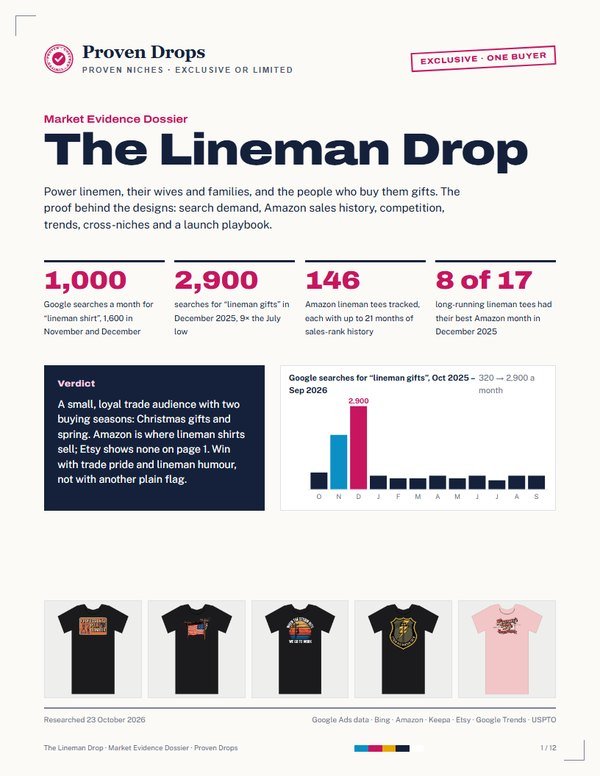
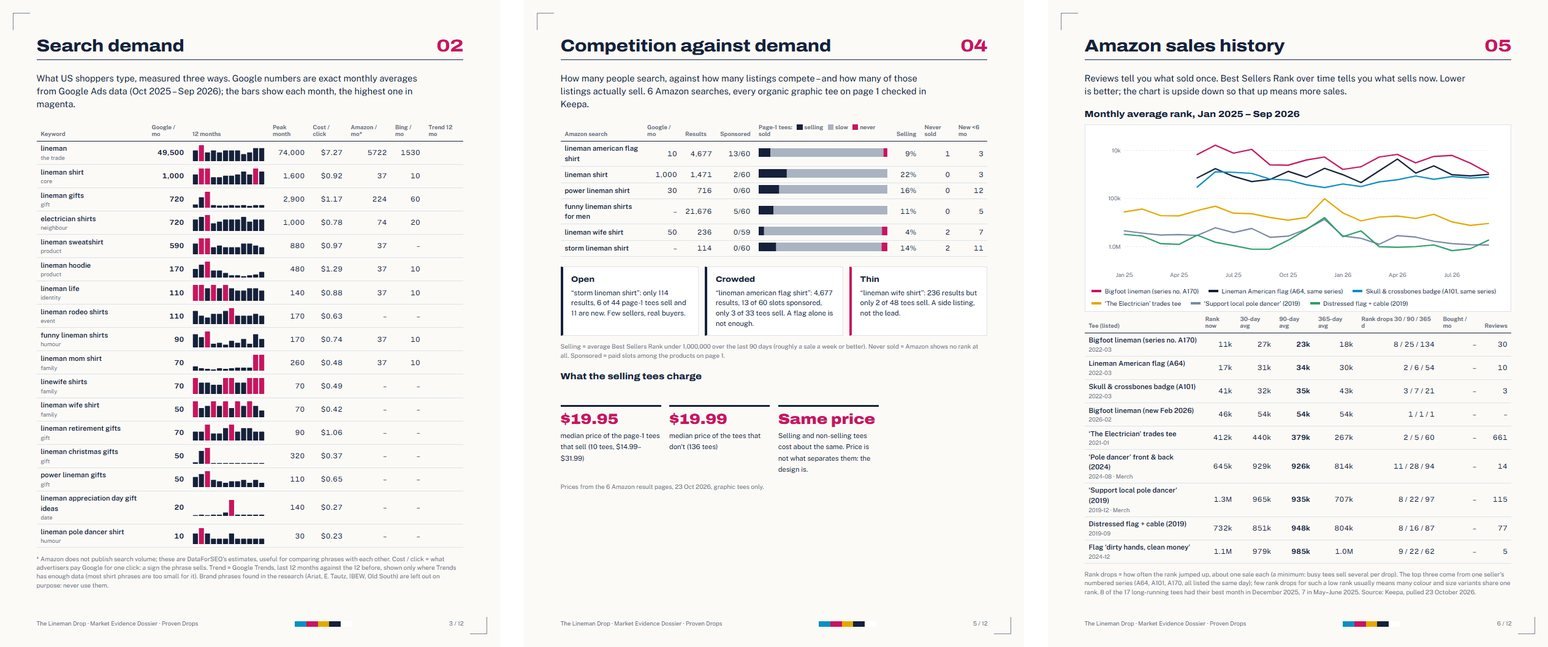
A 14-page PDF with the numbers behind the drop: exact monthly Google searches for every buyer phrase, Amazon and Bing numbers, 5 years of Google Trends, Best Sellers Rank history for the tees that already sell, and how many page-1 competitors actually sell.
Plus a short drop report: who the buyers are, the look they buy and the honest risks. Every number has a date and a source.
A lawyer's search: usually from about $500 (mine is a check, not legal advice)
Every word on the designs and in the listings, looked up in the US trademark register, with the record numbers so you can check them yourself.
Plus a list of words to avoid when you write your own listings.
Writing it yourself: an hour or more per design
For every design: an Etsy title, 13 tags and a description, plus an Amazon Merch title and two bullet points.
All checked against the character limits, ready to paste.
One seller, or at most ten
Exclusive drops are sold to one seller only, limited editions to at most 10. When a drop sells out, it's marked Sold on this page and never sold again.
The two editions never share a design.
Included
The best months for the niche, which products to add (sweatshirts, hoodies, tote bags) and which shirt colours suit each design.
Included
What the audience and its gift buyers actually type, and which searches belong to different buyers (football linemen, crochet patterns), so you don't waste your titles on them.
Right after checkout, in your Gumroad library.
Download the files one by one, or everything as one ZIP.

Sources: Google Ads keyword data (via DataForSEO), Bing, Amazon, Keepa, Etsy, Google Trends and USPTO. The dossier shows research into demand, not a promise of sales.
(The Lineman Drop: shirts for power linemen and their families)

Power linemen climb poles in storms so the rest of us get our lights back. They're proud of it, and so are the wives, moms and kids who buy them gifts.
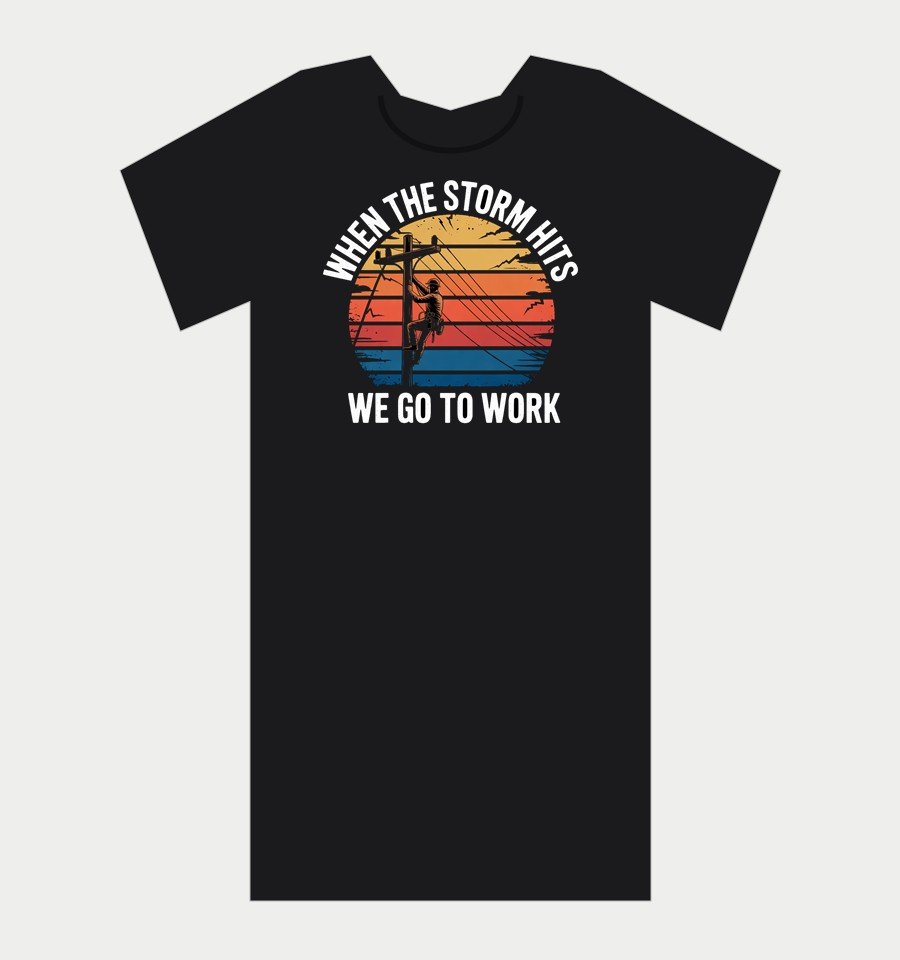
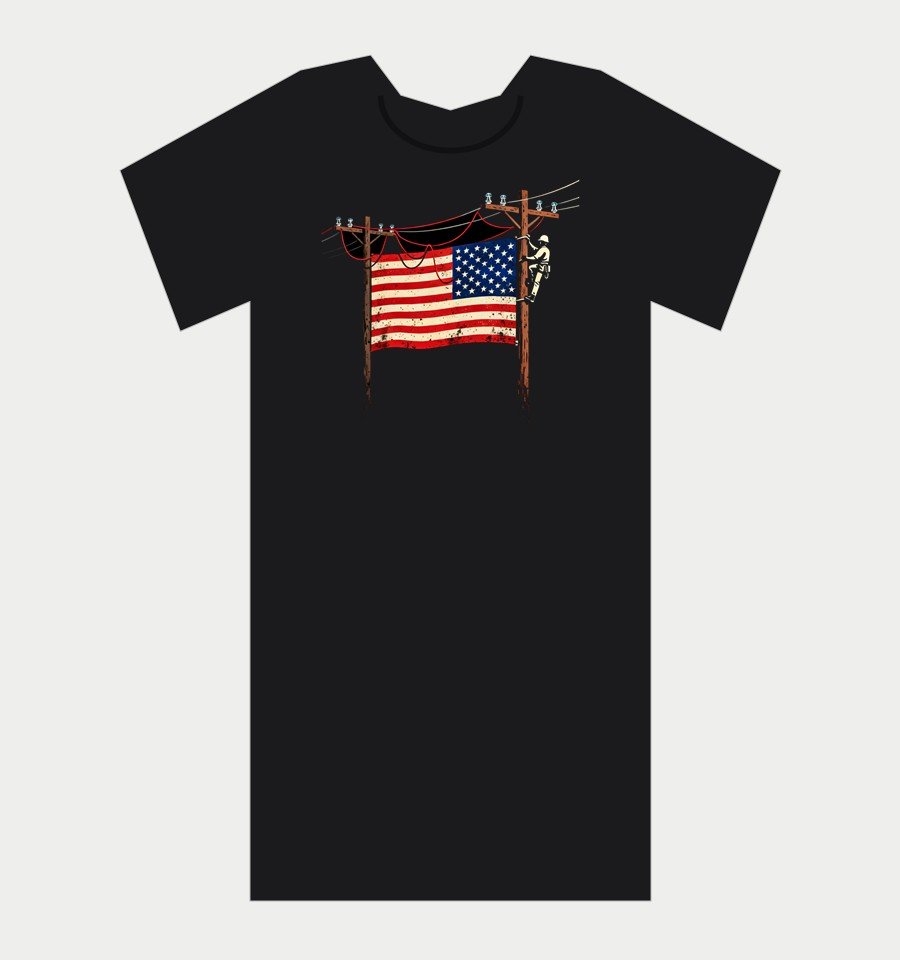
Their shirts show that pride: a lineman on the pole, the US flag, storm work.
Power linemen (mostly men 25–55) and their families. The research found 157 search phrases from linemen and 18 more from wives, moms and kids looking for gifts.
Yes. On Amazon, the top-reviewed lineman and electrician shirts have 205, 115, 93, 72 and 62 reviews.
The US flag with a lineman climbing, retro sunsets with a pole, storm work, trade humour, electrical symbols. Black and navy shirts with white, orange and safety-yellow ink. The drop keeps that look and draws it new.
"Journeyman lineman" sounds generic, but it was filed as a clothing trademark, so it's on no design and in no tag. "Lineman" alone also brings football fans, so every title says power or utility lineman.
My guarantee is simple.
Download your drop and look through everything: the designs, the proof, the trademark check and the listings. If you're not happy with it for any reason, email me within 30 days of purchase and I'll refund you in full. No forms, no questions. Your licence to the designs ends. An exclusive drop is then retired and never sold to anyone else; a limited edition never sells more than its stated places.
Done before a design is made
It's a careful check, not legal advice.
Both come with the same 14-page Market Evidence Dossier, drop report, trademark check and listing kit. An exclusive drop has 4–5 designs and is sold to one seller for $39. A limited edition has 3 different designs and is sold to at most 10 sellers for $15. The two editions never share a design.
Print-ready designs (transparent PNG, 4500 × 5400 px: 4–5 in an exclusive drop, 3 in a limited edition), the 14-page Market Evidence Dossier (PDF), the drop report with the trademark check (PDF), the listing kit (text file, ready to paste) and a README with your licence and a fingerprint of every design file. Download them one by one or as a single ZIP.
A 14-page PDF with the numbers behind the drop: exact monthly Google searches for 17–19 buyer phrases with a 12-month history, Amazon and Bing search numbers, the long-tail buying phrases (shirt, t-shirt, tee) with how many page-1 Amazon and Etsy listings already use each one, a competition analysis, 5 years of Google Trends, every page-1 Amazon tee on 6 searches checked for whether it sells, Best Sellers Rank history from Keepa, rising listings, neighbouring niches, a rating for each design and a 9-step launch playbook.
Google Ads keyword data (through DataForSEO), Bing, Amazon search results, Keepa sales-rank history, Etsy search pages, Google Trends and the US trademark register (USPTO). Every number in the dossier has its source and date, and estimates are labelled as estimates.
Yes. Each design is rated by the evidence (Strong, Good, Medium or Bet) with the best place to list it first. Where the data is thin, the dossier says so.
If you want designs nobody else will ever list, pick the exclusive. If you want to test a new audience for less, pick the limited edition: you may share those designs with up to 9 other sellers.
Possibly: the niche is public. The designs are not. Exclusive designs go to you alone; limited ones to at most 10 sellers. Neither is sold again after that.
Most of the research runs automatically, and the designs are made with AI tools and finished by hand. That keeps my cost low. Each edition is still sold only up to its limit.
No. I show you real proof that buyers are there, and the risks. Sales depend on your shop, prices and timing.
Yes, then checked and finished by hand. Etsy asks you to mention this; the listing kit includes a line you can use.
Yes: on products you sell on Etsy, Printify, Printful, Shopify, Amazon Merch on Demand, Redbubble and similar print-on-demand shops. You can change them and use them in your listings and ads.
No. Don't resell or share the files themselves.
Email me within 30 days of purchase for a full refund. Your licence to the designs ends. An exclusive drop is then retired; a limited edition never sells more than its stated places, and a refund doesn't open a new one.
No one honestly can. What I can promise is the work: every word checked in the official register, for every product type, again on the day of sale, with the record numbers in your report so you can see it yourself.
Checkout runs through Gumroad. The download link appears right after payment and is emailed to you.
(A print-on-demand seller, just like you)
I sell print-on-demand shirts myself, and for a long time I guessed what to sell. The receipt above was the result.
Then a design got rejected as "infringing" because one phrase was close to someone's trademark. That was the day I stopped asking "what do I like?" and started asking "who buys this, what do they already wear, and which words are taken?"
Proven Drops is the result: I do that work for one audience at a time, and one seller (or, for a limited edition, a few) gets the niche and the designs.
Three designs alone would cost $150 or more to commission.
Grab A Drop Today For…
$39 or $15
YES… SHOW ME THE OPEN DROPS!Pick an audience, download instantlyWhen a drop sells out, it's gone.
Price sources: Gelato and GearLaunch freelance design guides (2026), eRank and EverBee public pricing, US law-firm search fees, checked October 2026.
Wait! Before you go…
You've probably seen plenty of "proven niche" promises, so you're cautious. That's exactly the instinct this research is built for. But I'd hate for you to leave and miss this drop while it's still open, so let me make the decision easy:
$39 $12.87
67% off this drop. Code STAY67 is applied for you.
The offer stays open only while the drop is unsold. Once someone buys it, it's gone.
One last thing…
Maybe a full exclusive drop feels like a lot for a first try. Fair enough. Here's the smallest way to test an audience that already buys: a limited edition, with $7 off.
$15 $8
$7 off. Code START7 is applied for you.
When the places are taken, the edition is gone.